About the Journal
Real Coster: Jurnal Pengabdian kepada Masyarakat (E-ISSN 2807-6044) is an open-access, peer-reviewed journal devoted to the scholarly documentation of community service. It is managed and published by the Lembaga Penelitian dan Pengabdian kepada Masyarakat (LPPM) of Institut Agama Kristen REAL Batam, Kepulauan Riau, Indonesia, and is issued twice a year, in March and September.
Continuity of Publication
The journal has appeared without interruption since Vol. 1 No. 1 (March 2018), completing eighteen issues across nine volumes. It was founded under Sekolah Tinggi Teologi (STT) REAL Batam. Following the elevation of the institution to Institut Agama Kristen (IAK) REAL Batam by Decree of the Minister of Religious Affairs of the Republic of Indonesia No. 853 of 2026, dated 11 June 2026, the journal continues under IAK REAL Batam. The change affects the legal standing of the publisher alone: the title, E-ISSN, volume and issue numbering, editorial policy, and the entire back archive remain unchanged and permanently accessible.
Position
Real Coster publishes scholarly accounts of community service rooted in the Christian tradition of diakonia, and it does so because that work is seldom examined on its own terms. Churches, foundations, seminaries, schools, and clinics reach communities the state and the market serve unevenly, and they do so under obligations and relations of trust that have no secular counterpart. The journal treats both the service and the faith that shapes it as objects of serious analysis, and it publishes scholarship rather than activity reports. The requirements that follow from this position—what the journal publishes, what every manuscript must establish, and what falls outside its scope—are set out in full under Focus and Scope.
Scope in Brief
The journal is multidisciplinary and contextual, spanning community empowerment and livelihoods, education, health, disaster response, social inclusion, environmental stewardship, family and youth formation, peacebuilding and interreligious cooperation, and the service capacity of churches and Christian institutions.
Work grounded in other religious traditions, and accounts of interreligious collaboration in service, are welcome on identical terms and are reviewed by scholars competent in the tradition concerned. What the journal requires of every manuscript, whatever tradition it proceeds from, is that the religious dimension be shown to matter to the engagement itself. The full statement, including the categories the journal does not publish, is given under Focus and Scope.
Manuscripts are accepted in Indonesian and English, with English preferred.
Editorial Standards
The journal has progressively tightened its requirements, and the standards now in force apply to all submissions from (Vol. 10 No. 1, March 2027) onward:
- Every manuscript is first assessed by the editorial board and may be desk-rejected where scope, novelty, methodological grounding, or formal requirements are not met.
- Manuscripts that pass editorial screening undergo double-blind review by at least two reviewers drawn from outside the author’s institution.
- Reporting must be evidence-based and must establish each of the conditions set out under Focus and Scope, among them the situation before the engagement and how it was determined, the point at which and manner in which the community was involved, what did not work, what continues after the implementers withdraw, and what another community could take from the account. A manuscript that narrates an activity without establishing these things is returned without review.
- Submissions are screened for similarity using Turnitin, with a maximum tolerance of [20%] excluding the bibliography.
- References follow the Turabian style and must be managed through a reference manager. A minimum of [80%] of sources are to be drawn from primary and peer-reviewed literature published within the last ten years.
- Authorship, conflict of interest, funding, ethical clearance, and the use of generative artificial intelligence are to be declared in full, in accordance with the journal’s published policies.
- Every manuscript must demonstrate that the community consented both to the engagement and to its publication. Service conducted as a means of religious recruitment is not published, irrespective of the quality of the reporting.
These provisions are deliberately more demanding than those applied in the journal’s earlier years. They reflect a considered editorial decision: a community service journal earns its standing not by the volume of what it publishes, but by the reliability of what it reports.
Collaboration and Reach
Real Coster is no longer a local publication. Its recent issues carry work produced by authors from multiple institutions and conducted across widely separated regions of Indonesia—among others, the coastal communities of the Riau Islands, the upriver borderlands of West Kalimantan, East Kalimantan, and East Nusa Tenggara. Cross-institutional authorship is now the editorial norm rather than the exception, and the journal actively invites collaboration with universities, theological institutes, congregations, and service organizations beyond its own region and beyond Indonesia.
Accreditation, Indexing, and Access
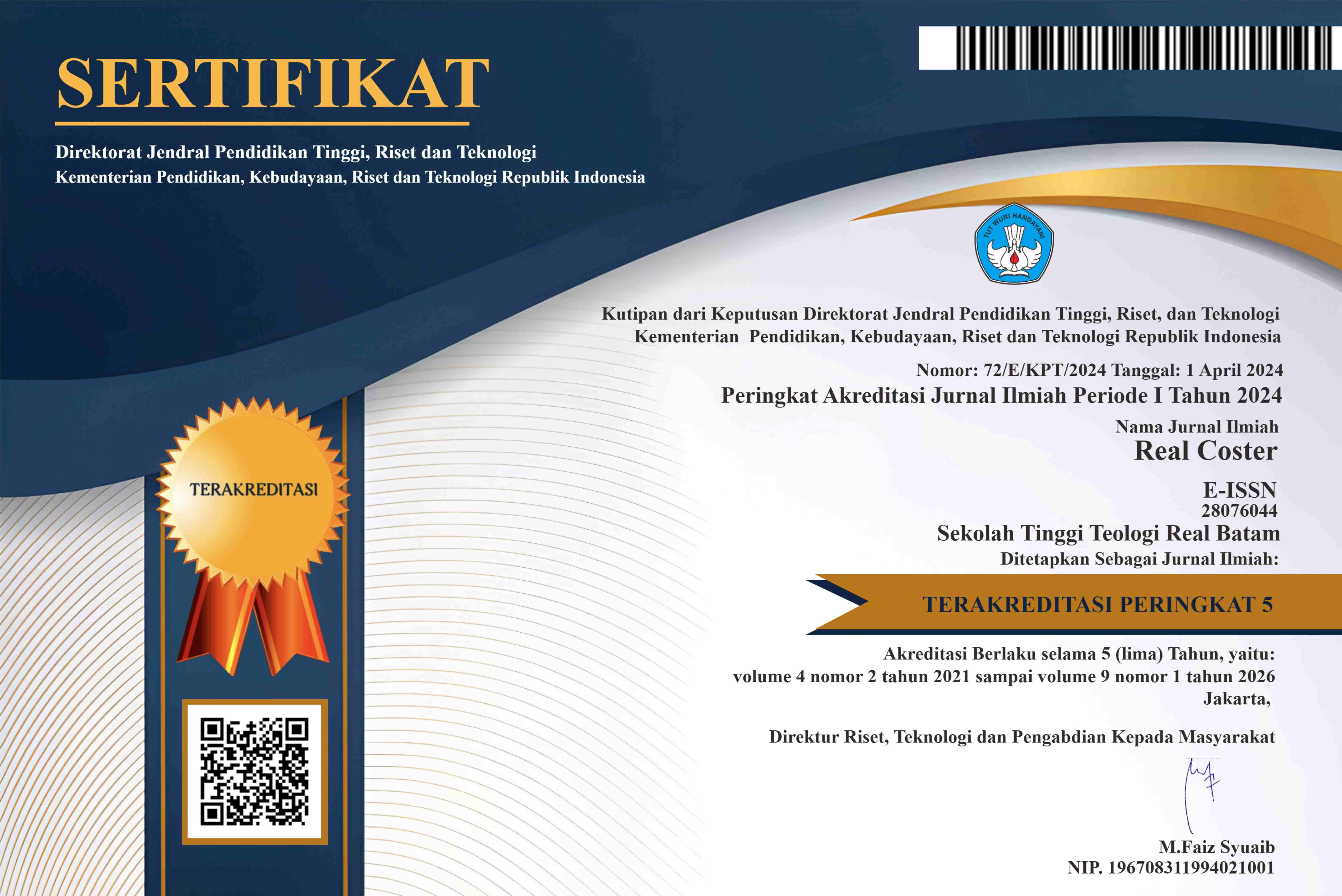
The journal is nationally accredited at SINTA 5 and is indexed in SINTA, Garuda, Google Scholar, Dimensions, BASE, ROAD, OneSearch, and Scilit. Every article is assigned a DOI registered through Crossref. All content is immediately and permanently open access under a Creative Commons Attribution-NonCommercial-ShareAlike 4.0 International License; authors retain copyright over their work. (Confirm APC statement).
Direction
The editorial board is working towards a higher national accreditation grade and inclusion in the Directory of Open Access Journals, and subsequently towards international indexing. That trajectory rests on one condition only, which the board regards as non-negotiable: that every issue published should be more rigorous than the one preceding it.